
Pontoosuc Lake, Pittsfield, MA


The Problem's We All Share, Norman Rockwell
“Perhaps there never was a country like the one on the cover of the Post, that I was stubbornly painting the best vision of us.”
– Norman Rockwell
When you imagine Norman Rockwell’s America you don’t usually think of it as a segregated one, but it was. And when you remember Norman Rockwell, you don’t typically recall an influential civil rights artist, but he was. Or so I discovered at the Norman Rockwell Museum in Stockbridge, MA.
While the rather small museum displays only a tiny fraction of Rockwell’s reported 4,000 works, many of which were lost to fire, it contains some of his most famous. Within its walls, visitors will find the hopeful and entertaining paintings like Runaway, Going and Coming, and Freedom From Want, that are most associated with Rockwell’s 47 year career as a Saturday Evening Post illustrator. But they’ll also find the more serious, and powerful work of Rockwell’s later life when, after leaving the Post, he turned to topics of civil rights and poverty. It was these images I found most intriguing and surprising. I’d always known that Norman Rockwell was a good illustrator. At the museum I discovered he was a good man as well.
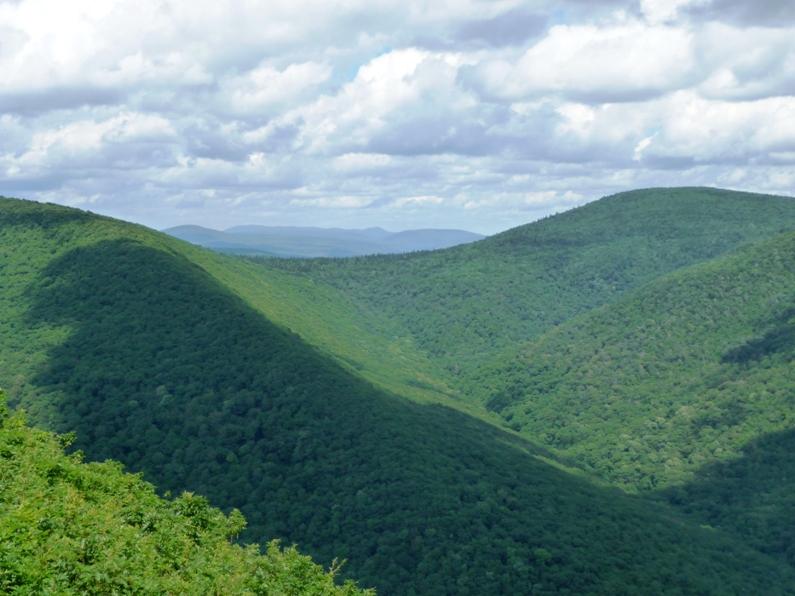
View from Stony Ledge
“All that most maddens and torments; all that stirs up the lees of things; all truth with malice in it; all that cracks the sinews and cakes the brain; all the subtle demonisms of life and thought; all evil, to crazy Ahab, were visibly personified, and made practically assailable in Moby-Dick. He piled upon the whale’s white hump the sum of all the general rage and hate felt by his whole race from Adam down; and then, as if his chest had been a mortar, he burst his hot heart’s shell upon it.”
– Herman Melville, Moby Dick
My, oh-my, Melville must have hated Mount Greylock to have written such vitriol.* For it is rumored that the snow-covered profile of this gently sloping mountain peak provided the inspiration for his leviathan, Moby Dick. From a distance, and with enough psychotropics, you can definitely imagine the mountain as the hump of a great whale breaching the surrounding granite waves. But our objective today wasn’t to view it from a distance, it was to summit Massachusetts’ tallest peak.

Mt. Greylock as seen from Herman Melville's house
That certainly sounds impressive, and it might have been, if only we had taken the nine or so hours needed to hike the entirety of it. But we were short on time and ambition today so we packed a lunch and drove to the 3,491 foot peak. From the summit you can see several mountain ranges (the Adirondacks, the Catskills and the Green Mountains) depending on which direction you look.

Stony Ledge Trail
While Greylock’s vista is admirable, the better view, in our opinion, is from the lower summit of Stony Ledge. Some 900 feet beneath its larger sister, Stony Ledge gives an excellent view of Greylock, as well as the undeveloped valley on its western slope. The hike to the ledge would have been fairly easy, but the wide trail just begged to be tackled via mountain bike, which proved to be harder than we expected. The entire trip is a hill, halfway up, and halfway down. Going down is loads of fun, but biking a mile or so straight up kicked the asses of a couple of fatties like us. Good thing we got back early enough for a nap.
(* This will wind Shannon up good, because Melville loved Mount Greylock. Heh, heh, heh, heh.)

Mr. Heatmiser
The nightly news keeps saying we’re still in the middle of a heat wave, but you wouldn’t know it from Lanesborough, MA. It’s 61 degrees here as I type and it isn’t supposed to get much above 80 all week. When the sun ducked behind clouds yesterday it actually felt a little chilly. Maybe it’s the higher elevation (1,130 ft) or because we’re in a valley between Mount Greylock to the north and Brodie Mountain to the south. I don’t know, but whatever the reason, it’s pretty great.

Europe Without Hotels, New York Times
If a perpetual traveler pays an average of $100 per night for hotel accommodations, over the course of a year he’ll pay an amount roughly equivalent to the annual mortgage and property taxes on a $600,000 house. That is kind of insane. And it’s not like $100 per night buys you opulence in most of the developed world, or even a working kitchen for that matter. It isn’t all that hard to find Comfort Inn’s that run about that much. No, mostly what that steep cost buys is the convenience of a temporary location. But that is still a pretty egregious mark-up for convenience. Even if it were affordable, there is something basically wrong with paying that amount of money to rent a small room. So we’re always on the look-out for alternatives.
R.V.ing is one such alternative, and one we’ve obviously taken to. It can be a fairly economical way to see a continent, although perhaps a little less so when the depreciation expense of your rig is included. Nonetheless, once we finally decide to leave these shores, it is entirely possible that we’ll trade our large American bus for a much smaller European “camper van.” I understand many European campgrounds sit just outside the major cities, and it is hard to imagine a better way to explore the countryside than with a motor home.
Even if we go that route, we’ll still want to spend a couple of nights, or maybe even entire weeks, in places like Paris and Prague. On those occasions, we’ll need to find lodging. So it’s nice to see innovative alternatives to traditional hotels becoming available. We’ve considered renting an apartment in select locations for weeks or months at a time. We’ve also considered doing “house swaps” with someone who wants to trade access to our New York City area pad for a house close to a different great destination.
And now I see this, from the New York Times: web sites that act as exchanges for people looking to rent out their living space. In practice, this seems like a mix between Bed and Breakfast and an apartment rental. On the one hand you have the “strangeness” of sleeping in someone else’s home, but also the benefits that come from making contract with a knowledgeable local. Quite like a B&B. We’ve found the B&B experience worked pretty well for us in the past, and I don’t see how this would be much different, except for the lower price tag, of course. Another benefit is the potential access to a real kitchen, something you only get with a full apartment rental or very high end hotel suites.
So called “peer-to-peer hotels” are not necessarily something we’d look to avail ourselves of now, although it might be worthwhile to try out if we make it up to Montreal or Quebec City this summer. But it is definitely good to see alternatives to, and competition for, the chronically over-priced traditional hotels. Three cheers for the internet!












 Everywhere Once