
Chilling at a cafe in Lexington, KY


Monet's Garden, Giverny France
More than just art, I find museums to store fantastic collections of memories. They’re life sized photo albums of our travels. It is always a great joy to find beautiful representations of places we’ve been, or to revisit a fantastic work we originally saw in a different city. It’s a bit like reliving the old and discovering the new all at the same time.
Shannon’s post from this morning reminded me of the terrific Monet we saw in Pittsburgh’s Carnegie Art Museum, which to me was more than just a painting. My first glimpse of Nympheas brought instant recognition and a flood of memories. I knew from the size and the shape of the canvas that this work was intended to hang in Paris’s awesome musée de l’Orangerie; a place we visited in 2007. The Orangerie has a world renowned collection of impressionist art, the centerpiece of which displays eight large-format Monets along the walls of two oval rooms. Pittsburgh’s Nympheas belongs to that series.
Standing in front of that painting I was several places at once. In Pittsburgh I appreciated a Monet. In Paris I photographed my wife who, in retrospect, would have chosen a different blouse for the occasion. In Giverny, I walked through Monet’s gardens and admired the water lilies that where the inspiration for these masterpieces. All of these experiences, past and present, embodied in one work of art. Is it any wonder we so enjoy museums?
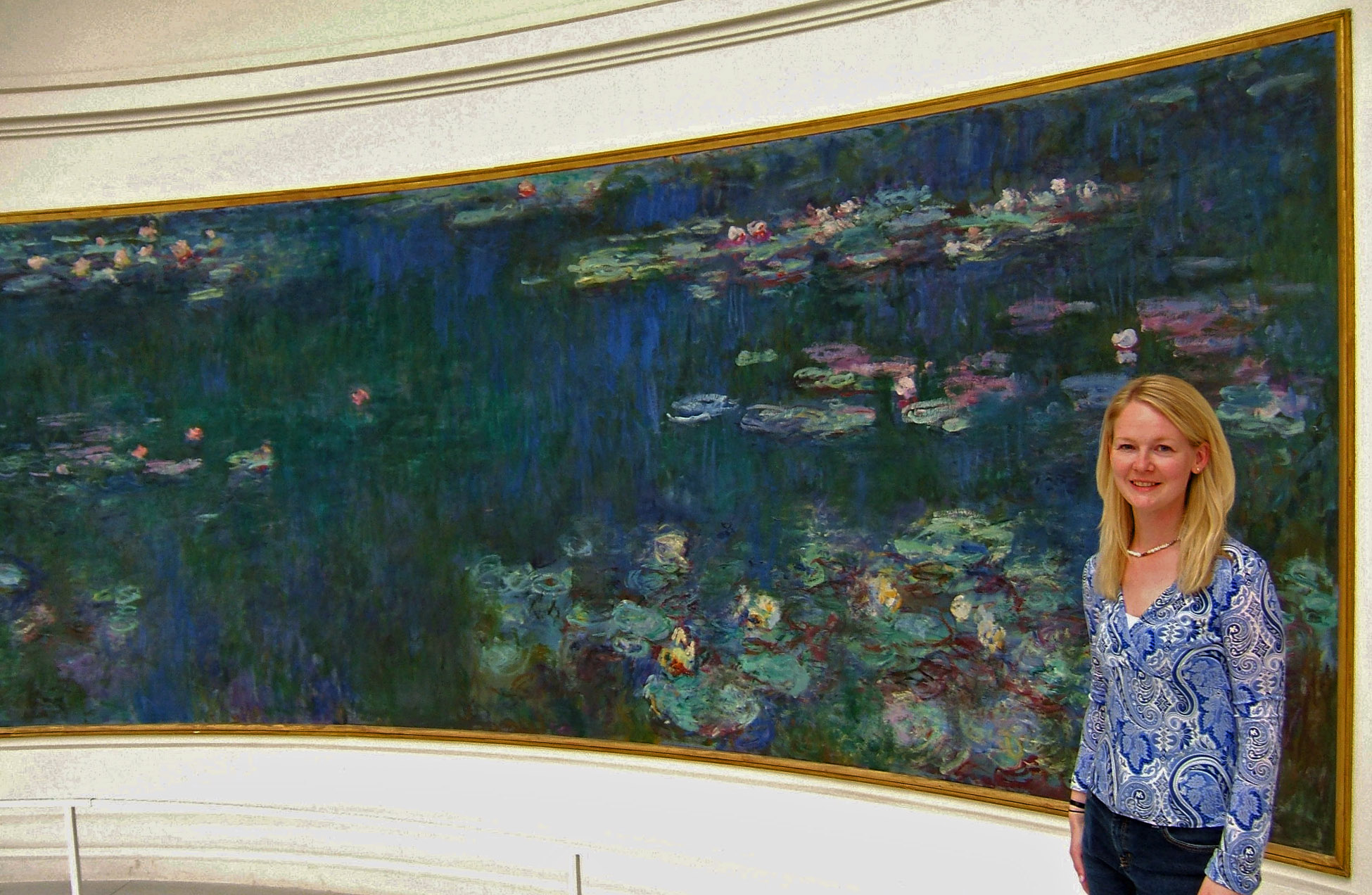
Shannon at Musee de l'Orangerie, Paris, France, 2007

As you might have gathered from Brian’s last post, we prefer our art bigger and bolder than a white canvas no matter how intricate the monochromatic layers are supposed to be.
Claude Monet’s Nympheas (Water Lilies) is one of the many colorful paintings on display in the Carnegie Museum of Art, which was founded more than a century ago and has one of the best collections we’ve seen during our U.S. travels.
Tycoon Andrew Carnegie envisioned a cultural temple where ordinary folks could marvel at European wonders they would never be able to afford to see in person. He conjured up the Hall of Architecture, a specially-built, sky lit room housing the third largest collection of plaster casts in the world.
A façade of a French Benedictine abbey takes up one entire wall, measuring about 40 feet high and 78 feet wide. We’ve seen the originals of some of the pieces, like the ornate bronze doors on the Baptistry in Florence. It’s a dazzling display. No convincing needed.


It’s a sales job that would make P.T. Barnum proud: convince the world that something every American family has done to their ceilings for decades is actually a visionary artistic accomplishment.
In all fairness, we did find the Robert Ryman exhibit to be one of the most entertaining in Pittsburgh’s outstanding Carnegie Museum of Art; although probably not in the way the artist or the museum intended. Read More…

For a period of time, as a child, I told people that I was the Bionic Man. I wasn’t, of course; but they didn’t know. How could they? I told them I was. At least that was the reasoning of a six year old boy.
Every time we pass a place like Paris, Arkansas or Rome, Georgia I remember my days as the Bionic Man. I can’t help but think that all of these places are trying to be something they’re not.
In a similar vein, a small town near where we used to live and immediately across the river from Manhattan calls itself West New York. Its proximity to the great city is so close that it could very easily be a borough. But unlike my impenetrable childhood lie, everyone here knows the truth. The town’s full name is West New York, New Jersey. Apparently they didn’t think through their cover as well as I did. I’d never have called myself Steve Austin Schmidt. If I did, nobody would have believed I was the Bionic Man. It’s so obvious.
But what West New York lacks in skilled subterfuge and apparently in self esteem it makes up for with one of the best views of the New York City skyline anywhere. Set high upon a bluff, carved eons ago by a river that still rages below, its unobstructed panorama stretches from the financial district at Manhattan’s southern most tip, northward past the Empire State Building, to the George Washington Bridge and beyond. It’s one of the best views anywhere in the world.
Mount Washington in Pittsburgh is the spitting image of West New York. So much so that I thought it was a mirage. We walked along a nearly identical street, lined on one side with two-family houses in a neighborhood that has seen better days. The opposing side disappears down a high cliff to a river that protects the towering Pittsburgh skyline like a moat. I’m told there is no better place to see the city than from this vantage point.
We went there for the view. We found a small slice of home.












 Everywhere Once