Archive | Travel RSS feed for this archive

Fit To Be Towed

The convoy has rolled to its final stop. We traded in our Audi for a Jeep in New Jersey, and got our tow assembly installed in Washington, D.C. For those who’ve asked us, incredulously, over the past several months why it’s taken us so long to set up, it’s because the whole thing is a bit of an ass ache. You can’t just throw a couple of bungee cords on the bumpers of any two vehicles and head off. The list of stuff needed to make this work reminds me of an earlier “Reality Bites” post. Things are never as easy as they should be, or as they seem.

To get ready to tow we needed to trade in our car. Call this “Ass Ache Number 1.” We liked our car and didn’t plan on parting with it for a long time. So running off to get a new one wasn’t something either of us was excited about. And our choices of new vehicle were severely limited. Most cars can’t be towed with all four wheels on the ground; even fewer with automatic transmissions can be. So we had to give up a car we liked for one that we were lukewarm on, at best. Yay! Our choices were further constrained by weight issues. The trailer hitch and the motor home itself are only rated to tow so much weight.
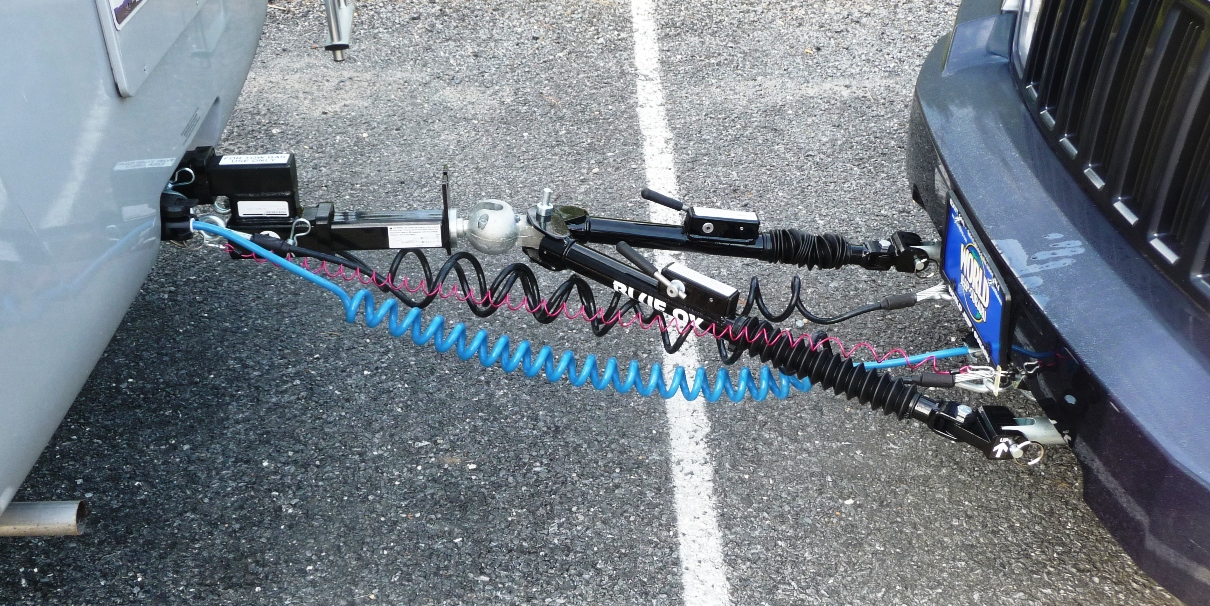
Height also ended up being a limiting factor, and one that we almost overlooked. Tow bar manufacturers recommend a vertical difference of no greater than four inches between the motor home trailer hitch and the tow vehicle base plate connection. After some research, we discovered that the base plate pegs for the Honda Fit, our original tow vehicle of choice, were 13.5 inches off the ground whereas the tow receiver on our motor home is 22 inches. Math is hard, but even I can figure out that 22 minus 13.5 is quite a bit more than 4. It is more than 4, right?

A robotic breaking system for our Jeep

Keep in mind that there isn’t anyone who will tell you this. You have to figure nearly everything out on your own, and hope you don’t mess it up too badly. Had we bought the Fit as originally planned, we probably wouldn’t have been able to tow it without a dolly. That would have qualified as a bad hair day.

After we side stepped that landmine, all we needed was a tow bar, base plates, safety cables, wiring to connect the tail lights of the motor home to the tow vehicle, a supplemental breaking system, and a mechanic to install it all. Piece of cake.

Setting this all up adds about thirty minutes to the front end and probably fifteen minutes to the backend of our travel time. It adds 20 feet of driving length to our 35 foot motor home and raises a whole host of potential problems, limitations, and hazards while in transit. But somehow this still seems more sensible than driving across country in tandem. Not by much, though.
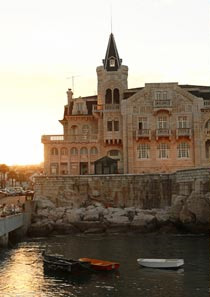
Wanderlust

I’ve been told that traveling in a motor home fulltime is an old-fart kind of thing to do. So it stands to reason that I’d also read AARP magazine. Well, I don’t, normally, but I did happen upon this month’s issue and was intrigued by their article “Paradise Found: Ten Best Places to Retire Abroad.” It’s a good list representing both traditional Latin American destinations and less traditional European ones. They surprisingly skip Asia completely, but it is always easy to nitpick a “best of” list, so I won’t.

Having just set out on our North American travels, we’re not looking to settle down at the moment, either abroad or anywhere else for that matter. But we do like the idea of living overseas someday for long enough to become locals: to learn the language, the culture, and the traditions. A year in any, or each, of these places would be fantastic.

I have to admit that reading this article stoked a desire to pick up and rent an apartment in Languedoc-Roussillon, France, which is funny considering we just picked up and bought an RV to travel in. And that reminded me of Shannon’s comment asking whether it is possible to have wanderlust while traveling. I know, for my part, it certainly is. Not wanderlust born of a “grass is always greener” kind of thinking, but rather from the simple recognition that there is so much to do and such a short time in which to do it. Visiting one destination necessarily means foregoing, or at least postponing, another. If one were to spend even a single year in each of the places suggested by the AARP article it would consume an entire decade. And as much as we’d love to do just that, we’d cover just ten places on three continents after all of that time. There is simply too much ground to cover.

So even as we travel we dream of other, more distant places we hope to visit one day, knowing full well that we can’t possibly get everywhere. It is both a curse and a great blessing. For as sad as it is to think of the places we’ll never get to, how much sadder still it would be to have already visited them all.

[Photo © Jason Varney / AARP Magazine]

A Virtual Stroll In Montreal

As with just about everything recently, we’ve had to adapt our style of travel to the realities of living in an RV. In the past, we would land in a city, pick up a map, and stroll around to get our bearings. We’d always feel helplessly lost at first, but within a couple of hours we usually owned the city. We’d know what could be done reasonably on foot, where we’d want to take the metro to, and what might require a taxi. We’d also have a strong sense of which things on our to-do list should be grouped together.

But now we don’t have a city hotel room to retreat back to after our stroll. If we want to explore the city, we have to get there first, and even that takes some degree of planning. Do we drive in or take public transportation? Where is the best place to park for what we want to do? In what order should we do things? All this, and more, has to be decided before we’ve even set foot in town.

Thankfully, Google has this neat feature where you can plot destinations on an interactive map.  This allows us to visualize our itinerary for Montreal, and capture some of the benefits of our stroll virtually. For example, we know we want to catch a free jazz concert on Thursday night, but we don’t know what else on our itinerary made sense to do the same day. After plotting a bunch of ideas on Google Maps, we can easily see what else is in the neighborhood.  The “walking directions” feature tells us that a walk from Notre Dame, to the Archaeology Museum, to Marie-Reine-du-Monde Basilica to the Jazz venue takes about 40 minutes; a pretty good day’s itinerary. More importantly, it tells us that the botanical gardens and the Jean-Talon Market are probably too far to walk, and too much of a pain for the metro. So we’re grouping them together and driving.

You can play around with our map here, to see how it works and maybe create something similar for your own next trip. In the future, we’ll be plotting more of our itineraries this way to get a feel of a city’s geography, if not its culture, before we arrive.

The Sisterhood Of The Traveling Plant

The strength of Shannon’s empathy for this plant is so great that one could rightly mistake her for a Druid (unless, of course, they were also aware of her notoriously black thumb).  For years, though, this hardy little plant has managed to not only resist her finger of death but also routine snacking by our first cat, Emma. It is a remarkable survivor.

Uncertain how the plant would fare in the RV, Shannon considered entrusting its care to her mother while we were on the road.  In the end, Shannon decided to take it with us. And it was good. Sunlight has done remarkable things for our spindly little friend, and it has thrived during our three months of travel.  But now, as we prepare to make way for the Canadian border, we are certain there is one thing this plant will not survive: customs. Either when crossing this way or that, some douchey customs agent will declare this little plant a dire national threat and, for the sake of God fearing Canadians or Americans everywhere, will do their heroic duty and have it destroyed.  Of this, we have no doubt.

Fortunately, we are close enough to relatives who kindly agreed to act as “plant sitters” while we don berets in le Canada Français.  Of course retrieving said plant upon our return will require a two hour round trip drive and a $25 ferry ride. Such is the burden of vagabonds who become attached to things.

Thinking Ahead

Europe Without Hotels, New York Times

If a perpetual traveler pays an average of $100 per night for hotel accommodations, over the course of a year he’ll pay an amount roughly equivalent to the annual mortgage and property taxes on a $600,000 house.  That is kind of insane.  And it’s not like $100 per night buys you opulence in most of the developed world, or even a working kitchen for that matter.  It isn’t all that hard to find Comfort Inn’s that run about that much.  No, mostly what that steep cost buys is the convenience of a temporary location.   But that is still a pretty egregious mark-up for convenience.  Even if it were affordable, there is something basically wrong with paying that amount of money to rent a small room.  So we’re always on the look-out for alternatives.

R.V.ing is one such alternative, and one we’ve obviously taken to.  It can be a fairly economical way to see a continent, although perhaps a little less so when the depreciation expense of your rig is included.  Nonetheless, once we finally decide to leave these shores, it is entirely possible that we’ll trade our large American bus for a much smaller European “camper van.”  I understand many European campgrounds sit just outside the major cities, and it is hard to imagine a better way to explore the countryside than with a motor home.

Even if we go that route, we’ll still want to spend a couple of nights, or maybe even entire weeks, in places like Paris and Prague.  On those occasions, we’ll need to find lodging.  So it’s nice to see innovative alternatives to traditional hotels becoming available.  We’ve considered renting an apartment in select locations for weeks or months at a time.  We’ve also considered doing “house swaps” with someone who wants to trade access to our New York City area pad for a house close to a different great destination.

And now I see this, from the New York Times: web sites that act as exchanges for people looking to rent out their living space.  In practice, this seems like a mix between Bed and Breakfast and an apartment rental.  On the one hand you have the “strangeness” of sleeping in someone else’s home, but also the benefits that come from making contract with a knowledgeable local.  Quite like a B&B.  We’ve found the B&B experience worked pretty well for us in the past, and I don’t see how this would be much different, except for the lower price tag, of course.  Another benefit is the potential access to a real kitchen, something you only get with a full apartment rental or very high end hotel suites.

So called “peer-to-peer hotels” are not necessarily something we’d look to avail ourselves of now, although it might be worthwhile to try out if we make it up to Montreal or Quebec City this summer.  But it is definitely good to see alternatives to, and competition for, the chronically over-priced traditional hotels.  Three cheers for the internet!