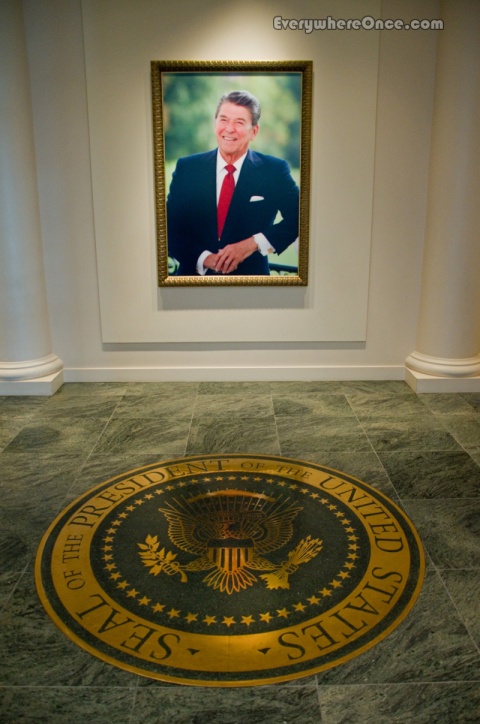
It is a powerful endorsement when a politically liberal and proudly lesbian friend recommends a visit to the Ronald Reagan Presidential Library. We knew right away that we’d find more there than mere political legacy polishing. And while there is no shortage of that at the Reagan Library, its collection also contains enough impressive artifacts of universal appeal to make it a compelling stop for political agnostics and Reagan critics too. It goes without saying that ardent fans of the late president will find lots to like in the Library, but history buffs may find some gems hidden within its halls as well.
Set on a hilltop above California’s Simi Valley, the Library’s sweeping views alone warrant a trip up Presidential Drive. Inside, the 243,000 square foot complex is a modern historical museum that leads visitors through Reagan’s life with a blend of placards, personal items and interactive exhibits. Some are trivial (green screen technology allows you to act out a scene from Knute Rockne alongside Ronald Reagan). Several are experientially awesome (entering a life-sized Oval Office replica and walking through Reagan’s actual Airforce One). Some are weighty (a short film chronicles the several-decade rise of communism near a barbed-wire clad replica of the Berlin Wall). While others are deeply fascinating.
Read More…
34.269447
-118.781482














 Everywhere Once