Ever since our first experiment with AirBnB (where we snagged a New York City...



Ever since our first experiment with AirBnB (where we snagged a New York City...

Just imagine, you’re in the Rome airport staring down the barrel of a...

It doesn’t seem possible, but it is completely true. Traveling 365 days every...

We were told that we’d have to be lucky to see any of the wild horses that roam the 6,000 acres of Paynes Prairie state park in Micanopy, Florida. If we were really lucky, we’d spot a member of the small bison herd that also calls the prairie its home. As it turns out, we were really, really lucky, and saw both; along with deer, alligators, armadillos, hawks, bald eagles, and a far greater number of interesting birds than we’d seen before in our lifetime.
The highlight, though, was this guy who crossed our path just as we were about ready to leave for the day. He was kind enough to hang out for a couple of photos after getting a drink at the stream below. He didn’t seem to fear the gators at all and just waded in like he owned the place. Then again, at six feet tall and over two thousand pounds he probably does.

Castillo de San Marcos, located in St. Augustine, FL, is the oldest masonry fort in the U.S.; constructed by the Spanish in the seventeenth century. It’s similar to Fort Pulaski, in that both are big, thick-walled, stone structure with canons and drawbridges. But we found Castillo de San Marcos more interesting. It’s probably the palm trees. Everything is better with palm trees.

Courtesy of Travel Channel, Man v Food
The Travel Channel’s Man v. Food is a disgusting show that highlights something truly disturbing about American culture. We, of course, love it. Mostly we love its gastronomic arm-chair travel to the country’s craziest, and most innovative, comfort food joints. We rarely watch a show without thinking that we need to get to one of the featured restaurants, diners, or sandwich shops. And if there is one thing we specialize in, it’s getting places. So that is what we’re going to do.
Last night was the last straw. An episode on Richmond, VA, featured a handful of great places we somehow missed when we passed through just a couple of months ago. Among them is the Black Sheep, serving up one of the most interesting sandwich menus I’ve ever encountered, under the moniker “The War of Northern Ingestion.” Anyone else craving a jerk barbecued chicken sandwich with roasted banana ketchup and peach chutney on French baguette? I have no clue whether it’s any good, but I know I’ve never had anything else like it, and I want one.
This year’s resolution is to never unknowingly miss such opportunities again. So we’re consulting the Man v. Food travel guides for all of our future stops, and have already compiled a seven page list of potential pig-out places.
Here’s to a happier, and heftier, 2011!

Prior to this trip, we hadn’t visited a wide variety of beaches. We almost never planned “beach vacations,” with the sole exception being a trip to Barbados. That lack of experience may explain our surprise in finding the sand at the beach in front of our St. Augustine campground made entirely of crushed seashells. I don’t know how common this is, but we thought it was pretty neat.

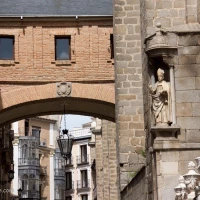
After eight months of continuous travel and 33 stops along the way, some destinations are still different enough to make us feel like we’re on vacation. St. Augustine, FL, was one of those places. To Northeasterners like us, palm trees and warm sun in December are enough reasons to admire this coastal Florida town. But its centuries old Spanish architecture is the real draw. Founded in 1565 by Spanish explorers, St. Augustine still retains much of its European aesthetic.
The city’s historic center is anchored by famous St. Georges street; a pedestrian thoroughfare lined with interesting architecture from various periods, some dating back to St. Augustine’s sixteenth century origins. The street’s touristy kitsch, while pervasive, is integrated well enough that it doesn’t detract from the experience; at least not overtly. There are no eyesores here. In fact, the area may be too pretty and too well maintained, if such a thing is possible. Because, for some reason, Shannon & I both felt like we were visiting a Disney replica of an old Spanish settlement, like something you’d find at Epcot Center, rather than an actual one.
 That may partly be because the area’s most impressive Spanish Renaissance buildings weren’t constructed by the Spanish at all; but rather by Standard Oil tycoon Henry Flagler. It was Flagler who turned St. Augustine into a winter resort for the wealthy elite in the late 1800’s, constructing several magnificent hotels to accommodate them. Today, those buildings serve other purposes and fortunately are open to visitors.
The Ponce de Leon hotel is now a girl’s dormitory for Flagler College, and is quite a contrast to the cinder block tower I lived in as an undergrad. The dining room looks like it belongs at Hogwarts, with its gold leaf stenciling and impressive collection of 79 complete Tiffany stained glass windows. I don’t know what they teach here, or how well, but I can certainly see the appeal of going to school near the Florida beach while living in one of the 18th century’s most exclusive hotels. Why didn’t I know about this place earlier?












 Everywhere Once