Ever since our first experiment with AirBnB (where we snagged a New York City...



Ever since our first experiment with AirBnB (where we snagged a New York City...

Just imagine, you’re in the Rome airport staring down the barrel of a...

It doesn’t seem possible, but it is completely true. Traveling 365 days every...

For a guy who doesn’t get terribly excited about hamburgers or, for that matter, fast food, how is it that I deliberately went out of my way to find one of the worst fast food hamburgers I have ever eaten? I blame crowdsourcing. More specifically, I blame Yelp.
In many ways user review websites like Yelp and TripAdvisor are brilliant. Their millions of members review far more locations than a professional opinion writer ever could. In fact, it’s hard to find something in the world these days that hasn’t been assigned a specific number of stars. And unlike the magazine or guidebook reviews of old, these never go stale because they’re updated continuously.
They’re also supposed to be better. Instead of turning to a crusty old food critic, Yelp relies on “the wisdom of crowds” for its rankings. In theory, the collective view of a large population is better than that of a single individual, even a very knowledgeable one. This idea is the basis for everything from the efficiency of capital markets to Wikipedia. A million internet users, after all, can’t be wrong.
Why, then, are they so often wrong?
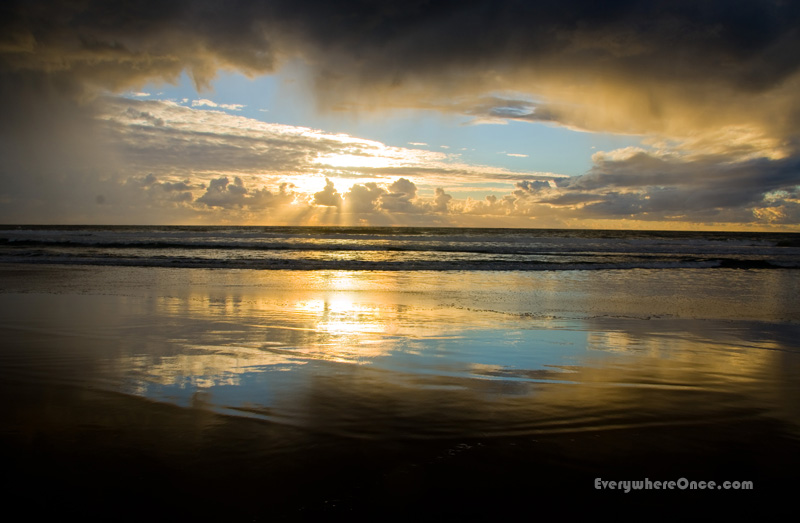
Pacific Beach, California
It took me by surprise. Not the ocean. That we found right where we expected to. What surprised me was the strange sense of accomplishment that washed over me upon seeing it.
Almost three years ago we set out to travel the country by motor home. During that time we’ve followed the seasons north and south like migratory birds methodically making their way from cool place to cool place. Along the way we’ve tried to keep our drive times short and avoid backtracking whenever possible. Do that long enough and you eventually drive from coast to coast without ever specifically planning to. That is, after all, how we ended up on California’s Pacific Beach.
It’s not the first time we’ve been to the Pacific Coast. But this time was somehow different. Driving across the country is the kind of thing that frequently appears on “Bucket Lists.” Not many people actually do it even though it represents one of the quintessentially American travel dreams.
We never really thought much about it, though. Driving coast to coast wasn’t ever a specific objective of ours. We embarked on this Great American Road Trip not to cross the country, but to see it. Getting from place to place, even from shore to shore, was never more than a means to an end. Which is why it surprised me that arriving at this ocean, so similar to the one we left long ago but for its cliff-lined coasts and sun that sets where it should rise, felt like victory.
It’s a strange thing to feel accomplishment in crossing off a goal I never set from a list I never wrote. Somewhere I must be keeping a bucket list of sorts, one that is secret even from me. Driving across country is apparently on that list, now proudly checked off.
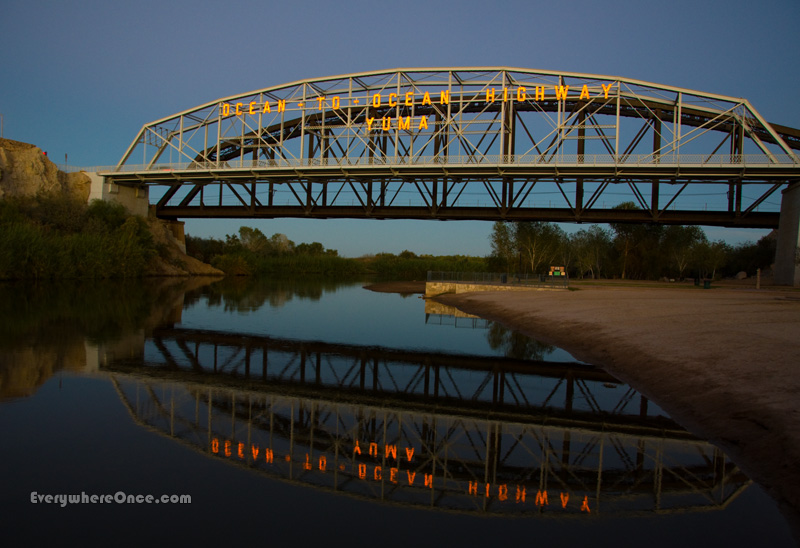
It’s a strange name for a bridge that doesn’t come within 170 miles of the nearest ocean. But once upon a time this little span that physically links Arizona with California over the Colorado River was the only automobile crossing that connected East and West for 1,200 miles. If you wanted to drive from coast to coast in 1915, the Ocean to Ocean bridge was one of the few ways to do it.
Legend has it that during the Great Depression California officials exploited this bottleneck by creating a makeshift immigration checkpoint at the northern end of the bridge. Folks trying to migrate west in search of work found the bridge guarded by California policemen who frequently turned people back. To this day a section of Yuma is called “Okie Town” for the population of Oklahomans who settled there after being turned away at the California border.
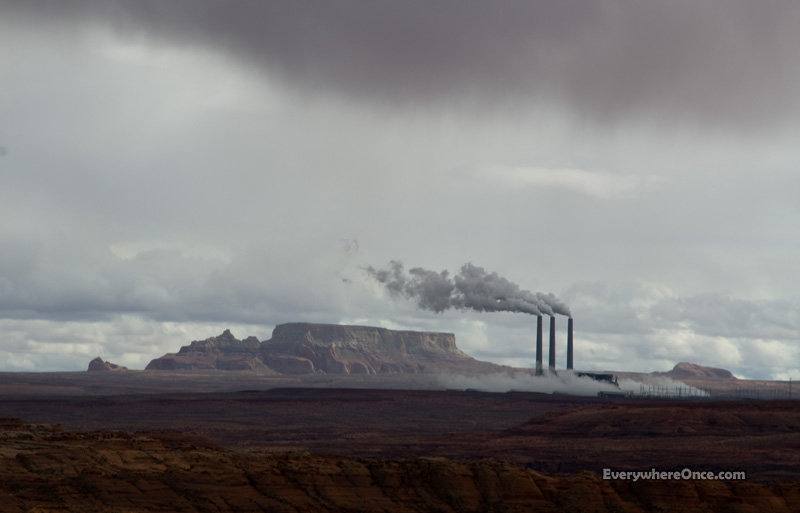
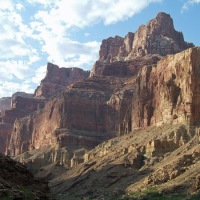
On a cold and cloudy day, billowing steam from the giant 2,250 megawatt coal-fired Navajo Generating Station gives the impression that this otherwise pristine desert landscape just outside Arizona’s Glen Canyon Recreation Area is really an industrial wasteland. On a clear day, though, the steam and fog dissipate to reveal majestic red rock buttes and a yellowish band of smog drifting downwind from the plant as far as the eye can see.










 Everywhere Once