This spider monkey commandeered our ship for a time as we sailed down the New River toward the Mayan ruin Lamanai in Belize.


This spider monkey commandeered our ship for a time as we sailed down the New River toward the Mayan ruin Lamanai in Belize.
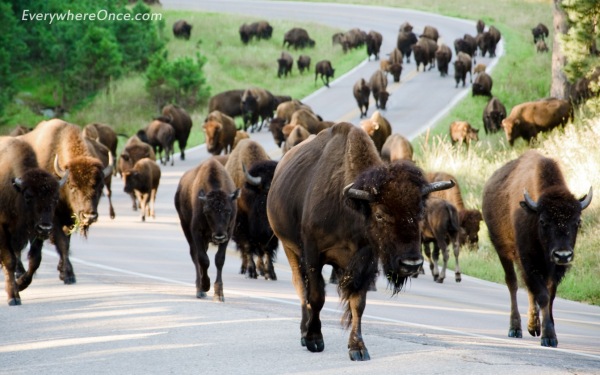
Last week someone resurrected this old post on Custer State Park to challenge my description of these woolly critters as buffalo instead of bison. My recollection is that here in the States, the American Bison is also called the American Buffalo. The following photo is a buffalo nickel, after all. So while it is technically true that these aren’t buffalo, we do use the names interchangeable in the U.S. And that is important, as you’ll see in a moment.

In confirming my recollection, I discovered something far more interesting. The scientific name for these creatures is actually Bison bison. A sub-species even goes by the name Bison bison bison. Why is this interesting? Because it allows us to construct a grammatically correct nine word sentence using just a single word. If we imagine a herd of plains bison living in a certain city of western New York who deceive some of their brethren, then we have the following:
Buffalo buffalo buffalo buffalo buffalo Buffalo buffalo buffalo buffalo.

Imagine living out of a suitcase no bigger than a 1.5 square foot box. That’s basically what Shannon and I did for two months backpacking around Central America. We’re proud to report that not only did we have the smallest bags of anyone we met but that our 40 liter packs were perfectly adequate for this specific trip.
While “perfectly adequate” is a true enough description of what we experienced, “barely adequate” fits too. We’d have been in trouble if we needed to plan for colder weather or multiple seasons. Traveling through Central America we had the luxury of packing lightweight clothing, although the highlands of Guatemala got surprisingly chilly. I was happy to have a heavy fleece I didn’t originally intend to pack but brought along because Houston was so damn cold when we left.
Even in colder climates, we probably could have made the 40 liter backpacks work if not for all of the electronics we hauled: two laptops, a digital camera, a video camera, an iPhone, a surge protector, a universal power adapter, battery charger, and the cables needed to power all this junk. Leaving the electronics at home would have freed up almost an entire bag – but we’d never do that.

Not one other traveler we met had Belize’s Community Baboon Sanctuary (CBS) on their itinerary. Most had never heard of it, which is a shame because it is definitely within the top three things we did in Central America. Tikal gets all the attention. Savvy travelers know that ATM Cave is a must do, but CBS should also make any list of top sights both because of the sanctuary’s awesome work and the unique opportunity to have an up-close encounter with wild and endangered black howler monkeys.
In 1985, 12 private landowners banded together to preserve their property as a sanctuary for black howler monkeys (called “baboons” in the local Creole dialect). Over the years, CBS has grown to over 200 landowners, in seven villages, who have voluntarily dedicated their 20 square miles of land to arrest the habitat destruction that, left unchecked, will cause an estimated 60% population decline over the next three decades. Meanwhile, the “baboon” population at the sanctuary has tripled in size to over 2,000 monkeys.
CBS is considered the first conservation effort in the world to rely exclusively on local community cooperation to protect an endangered species. Local landowners benefit directly from the ecotourism revenues generated by the sanctuary creating a win-win scenario for both man and beast.
We’re happy to have lent a hand in the continuation of this good work, and delighted to meet the furry residents in the bargain.

Over the course of our three hour commute from Punta Gorda to Placencia in Belize we got to talking with a couple from the U.K. When the boat docked we said our goodbyes. They turned to their guidebook to look for accommodations and we consulted a map to chart the best course to the guest house we had booked a couple days earlier.
As we waited for our room to be ready we pulled up a seat at a “road”-side restaurant and watched the throngs of tourists from what looked like a cruise ship convention amble by. Apparently it was the last day of some kind of festival and the place was mobbed.
Before we finished our lunch we saw the U.K. friends we had traveled with earlier in the day, only this time they looked dejected. They couldn’t find a room and were leaving. From Placencia they’d have a four hour bus ride to Belize City, on top of a likely hour or more wait for the next bus. By the time they arrived in Belize City the last water taxi to their next destination, Caye Caulker, would have long since sailed. “All part of the experience,” they said.









 Everywhere Once