Archive | Florida RSS feed for this archive

Down In The Boondocks

“Boondocking” or dry camping is RV slang for camping without the benefit of utilities: electric, water, and sewer. Shannon & I have never “boondocked” before, because it was never necessary to visit the places we wanted to go. Even the state campgrounds always had water and electric service. But Everglades National Park is a different story, and we’ll be without hookups for a week. It will be a nice test-run to see how we like, or at least how well we’ll cope with, “primitive” camping.

But “primitive” is relative. We’ll carry in 86 gallons of fresh water in our holding tanks and will have a generator and battery back-up for limited electric service. We’ll burn propane for heat and hot water. Even our refrigerator runs off of propane. So there won’t be much we’ll do without. Basically, it’s roughing it for pussies, which is right up our alley. But we’ve never done it before, so it’s new to us. And it is an exercise in conservation. Although we can carry in a lot of stuff, whatever we carry in is what we have to work with. We’ll be 50 miles from the nearest grocery store, which is kind of the point. But being so far from civilization requires a bit more planning than most places where you can run out for whatever you forgot.

I’m looking forward to it. Not only are we going deep into mostly undeveloped territory, we’re also laying the groundwork for many more similar excursions waiting for us down the road.  How exciting.

John Pennekamp State Park

John Pennekamp Coral Reef State Park

The idea of a state park that is completely submerged struck us as both different and cool. When we heard that John Pennekamp Coral Reef State Park in Key Largo, FL was the first undersea park created in the U.S., we put it on our list as a must-see destination. When combined with the adjacent Florida Keys National Marine Sanctuary, the park encompasses 178 square miles of coral reefs, seagrass beds and mangrove swamps. These areas protect and preserve the only living coral reef in the continental U.S.

Our original intention was to spend the day snorkeling, but the water and air temperature was a bit too cold. So we opted for the next best thing, a glass bottom boat ride. The 2 ½ hour tour passed over a number of shallow reefs teeming with wildlife, none of which allowed me to successfully photograph them. It was a worthwhile excursion, but next time we’ll come a little later in the year so we can explore these underwater treasures with our faces in the water.

Hospital Visit

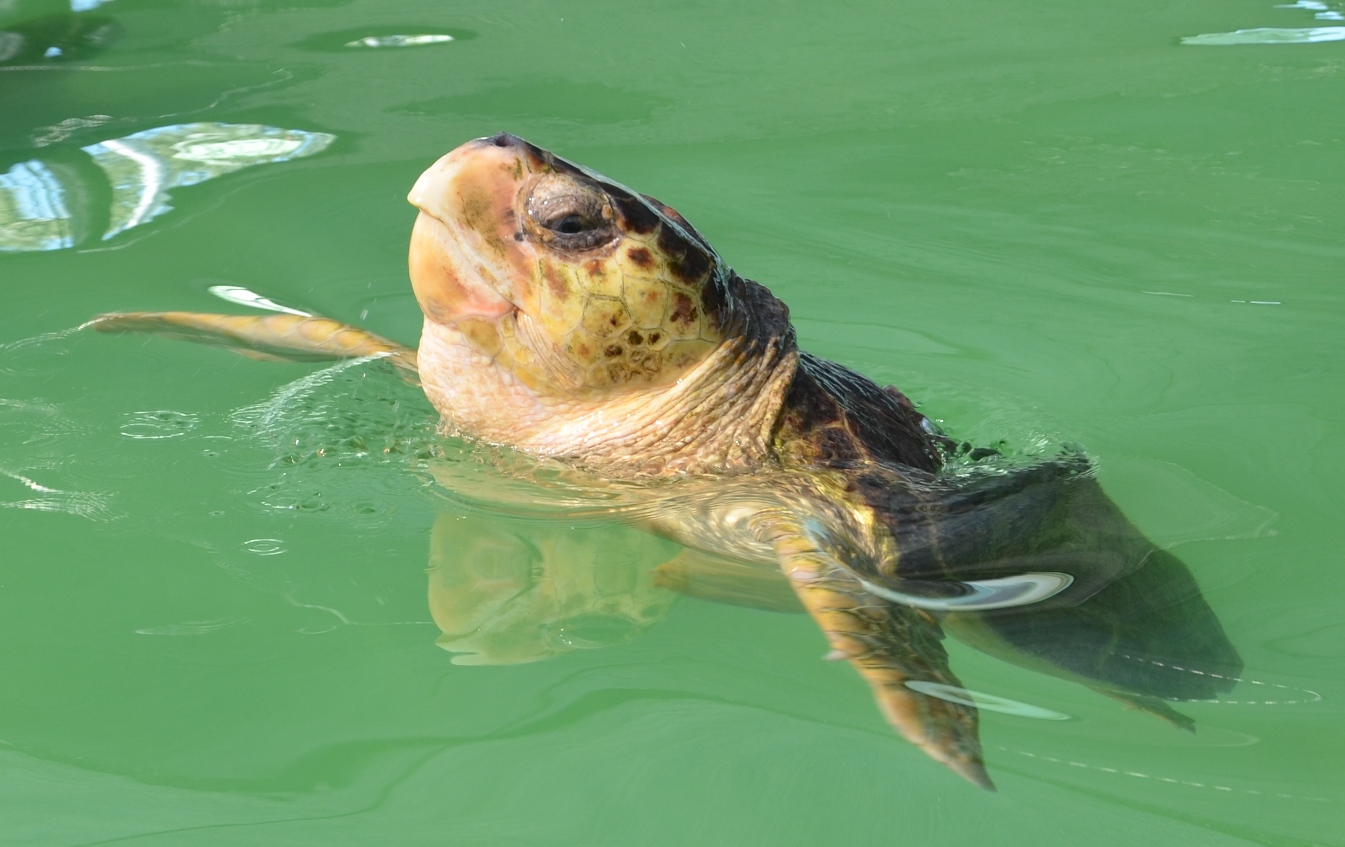
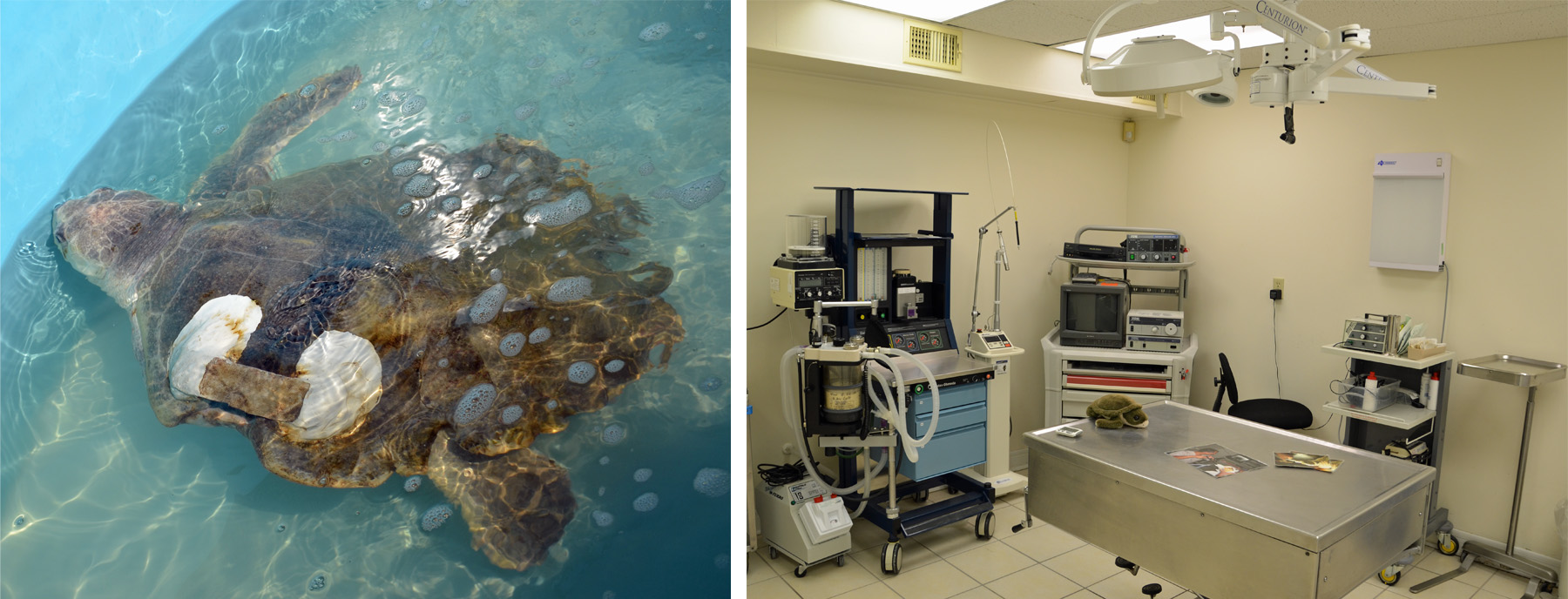
Turtle ImageWith a stainless steel operating table, an IV stand, an x-ray machine, and other medical equipment, it could have been a doctor’s office anywhere. But the patients treated there have flippers, are able to stay underwater for hours, and can weigh several hundred pounds.

Unlike Merina and the other showoffs at the Dolphin Research Center on Grassy Key, the residents at the Turtle Hospital a few miles away were more reserved and didn’t seem to care they had an audience. Maybe we lacked the proper bedside manner.

The Hospital’s goal is to rescue, rehabilitate, and then reintroduce the turtles back into their native environment. If one can’t survive in the wild, he or she becomes a permanent ward of the Hospital and makes its home in a 100,000 gallon saltwater swimming pool.

The most common ailment afflicting the sea turtles is fibropapilloma. The tumors are cauliflower-like in appearance and grow on soft tissue, including the eyes and mouth which makes feeding problematic, and have to be surgically removed. Several turtles had been hit by boats, with gashes that will never fully heal visible on their shells. Others ingested trash or fishing hooks, while some had to have flippers amputated after becoming tangled in fishing line.

Since it opened in 1986, the Hospital has treated and released more than 1,000 sea turtles of four different species: Loggerhead, Green, Hawksbill, and Kemp’s Ridley, all of which are endangered. Sea turtles are some of the oldest creatures in existence. Perhaps if we modern-day humans clean up our acts they’ll be around for a while longer.

Turtle Hospital, Marathon Key, Florida

An injured turtle with a missing flipper and wearing a weight to correct bouyancy problems (left). The emergency room where he was saved (right).

Pelican Parade

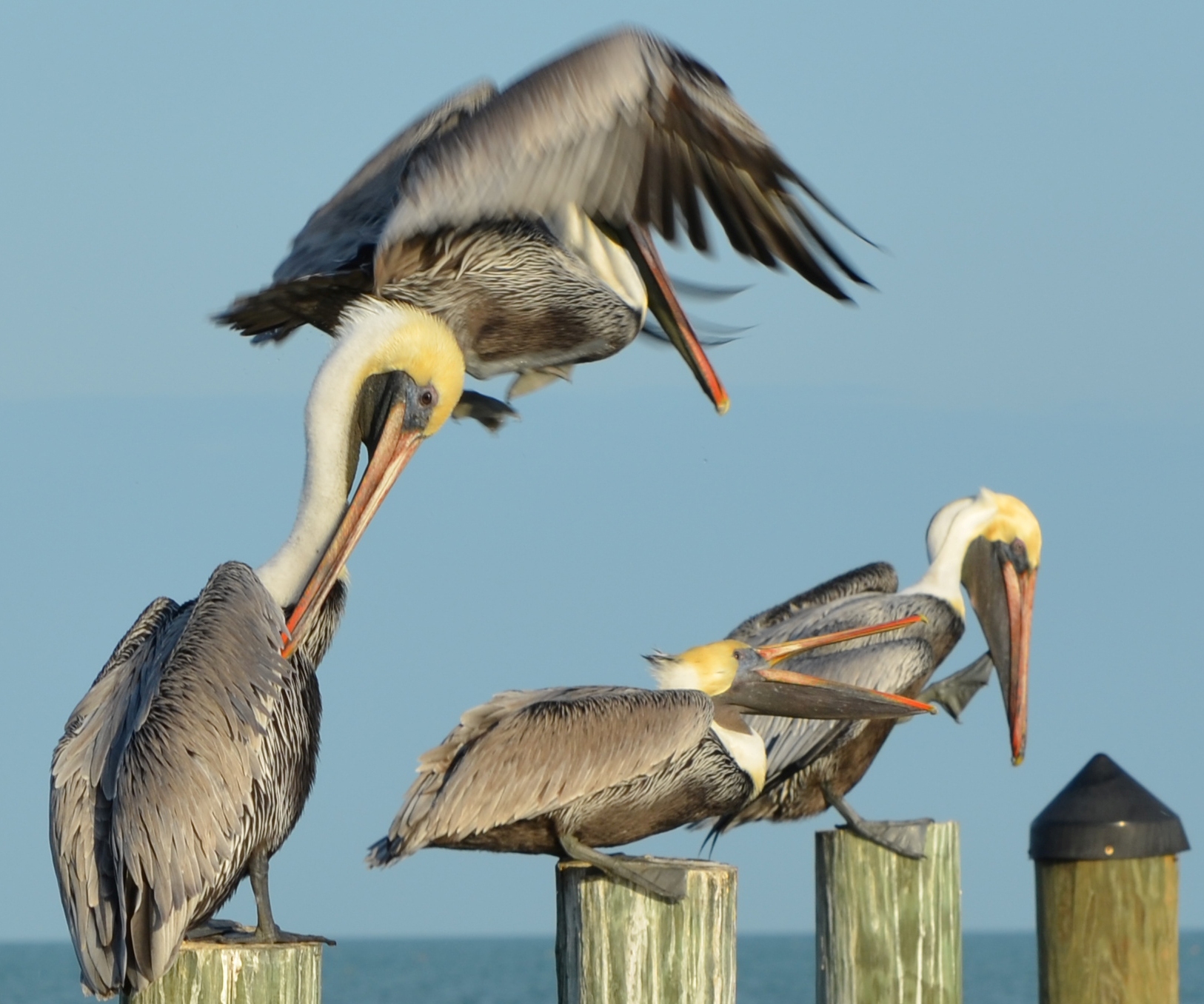
This scoop of brown pelicans was our constant companion at the campground in Grassy Key. Watching them fish in the ocean and cavort on the dock was every bit as captivating as watching the sun go down over Florida Bay. I didn’t see “Pelicans” listed as a campground amenity, but I think they should be.

Pelican Image

Pelican Image

Pelican Image

I Believe I Can Fly

Dolphin Research Center, Marathon FL

From this photo you might think the Dolphin Research Center in Marathon Key is a top secret military installation that is developing the latest in dolphin missile technology. But instead, they’re a not-for-profit education and research facility dedicated to the study, rescue and rehabilitation of the marine mammals. DRC’s research ranges from immunology to demonstrating that dolphins have a better understanding of numbers than many humans I know. DRC also runs a wide variety of educational programs for the public, including “dolphin encounters” that allow visitors to swim with the creatures.

The interactive programs run as much as $189 per person for just 20 minutes with the dolphins, which after seeing them first hand, didn’t seem like a good deal. So we stayed out of the water today, and found watching from the sidelines rewarding enough. We learned a lot while we were there, and naturally watched the dolphins perform a bunch of tricks . . . the same kind of thing you’d see at Sea World, I imagine. But we often found it more interesting to observe the dolphins when the trainers weren’t around.

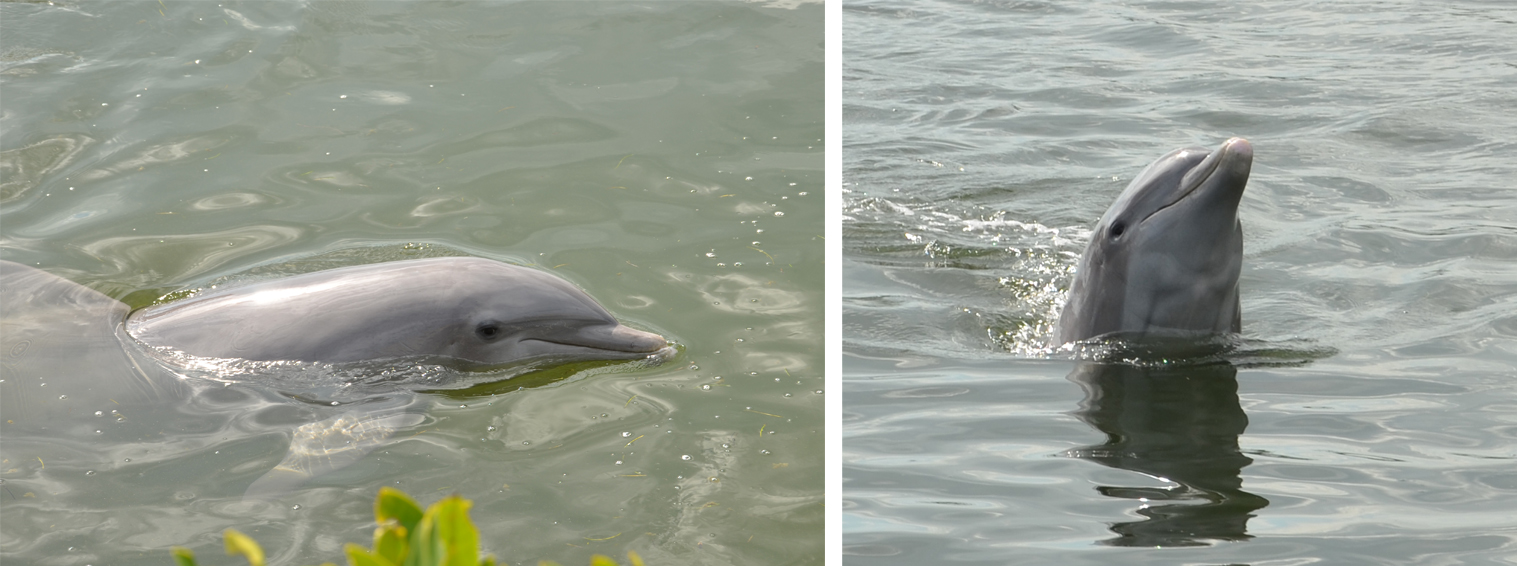
One flirtatious dolphin, named Merina, spent a good 15 minutes, or more, playing hide and seek with us. She’d pop up in front of us, with one eye out of the water, looking us over, only to disappear and pop up somewhere else; always making sure we were watching her antics. We had no food for her (feeding the animals is prohibited), and she had no hope of any kind of reward from us, other than our attention, which is apparently all she wanted.

Dolphin Research Center, Marathon Key

Merina the flirt.