Ever since our first experiment with AirBnB (where we snagged a New York City...



Ever since our first experiment with AirBnB (where we snagged a New York City...

Just imagine, you’re in the Rome airport staring down the barrel of a...

It doesn’t seem possible, but it is completely true. Traveling 365 days every...

The Great Library of Alexandria was charged with accumulating all of the world’s knowledge and was the largest library of the ancient world; or at least that’s what I learned from the game Civilization, which is pretty much where I get all of my history (that and certain Mel Brooks movies, of course). But the “Great” Library was just a trifle compared to the 142 million items contained in the Library of Congress, the largest library ever assembled.
As with much of our history, we owe a lot to the Brits who destroyed Congress’ first library during the War of 1812. The original library was narrowly focused on legal texts assembled to aid Congress in its role as a law writing body. Its destruction gave Thomas Jefferson the opportunity to successfully argue for a more comprehensive library; his: considered, to be one of the best in the U.S. at the time.
The acquisition of Jefferson’s library was a bit controversial as the collection covered a wide range of subjects, from science to philosophy and included a large number of foreign language texts. But Jefferson, an adherent of the Enlightenment, argued that legislators should be well versed in all manner of subjects. “I do not know that it contains any branch of science which Congress would wish to exclude from their collection; there is, in fact, no subject to which a Member of Congress may not have occasion to refer”, said Jefferson.
Over the years the Library of Congress continued to expand under this Jeffersonian philosophy of universality. As a result, our government now has the finest collection of information in the world to which it can refer and then, apparently, ignore.
 The convoy has rolled to its final stop. We traded in our Audi for a Jeep in New Jersey, and got our tow assembly installed in Washington, D.C. For those who’ve asked us, incredulously, over the past several months why it’s taken us so long to set up, it’s because the whole thing is a bit of an ass ache. You can’t just throw a couple of bungee cords on the bumpers of any two vehicles and head off. The list of stuff needed to make this work reminds me of an earlier “Reality Bites” post. Things are never as easy as they should be, or as they seem.
To get ready to tow we needed to trade in our car. Call this “Ass Ache Number 1.” We liked our car and didn’t plan on parting with it for a long time. So running off to get a new one wasn’t something either of us was excited about. And our choices of new vehicle were severely limited. Most cars can’t be towed with all four wheels on the ground; even fewer with automatic transmissions can be. So we had to give up a car we liked for one that we were lukewarm on, at best. Yay! Our choices were further constrained by weight issues. The trailer hitch and the motor home itself are only rated to tow so much weight.
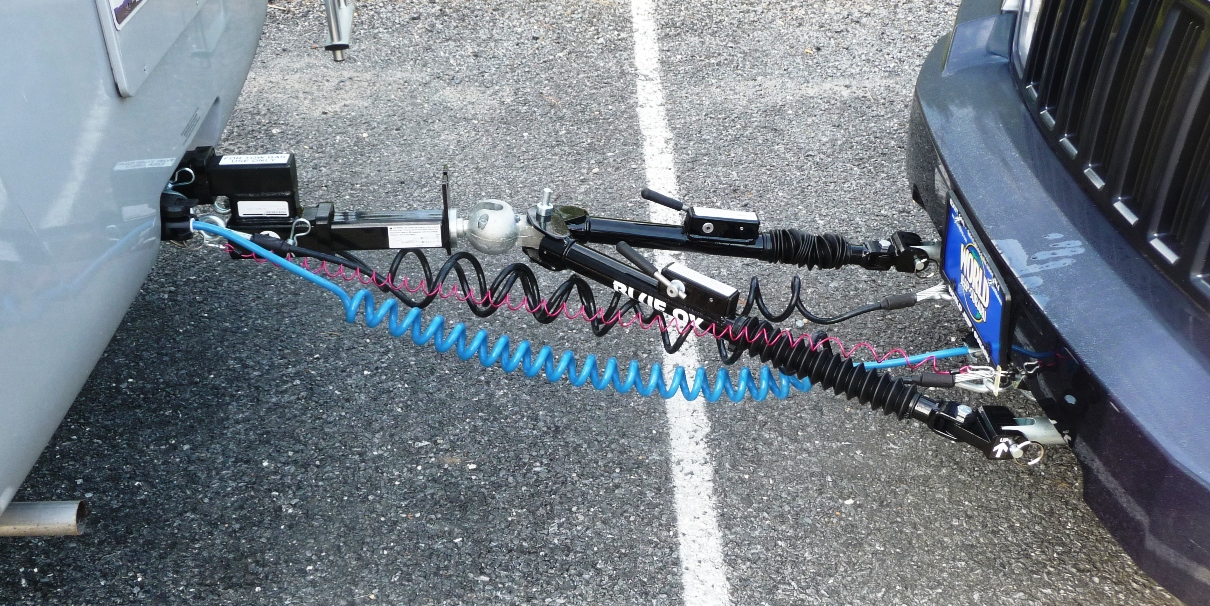
Height also ended up being a limiting factor, and one that we almost overlooked. Tow bar manufacturers recommend a vertical difference of no greater than four inches between the motor home trailer hitch and the tow vehicle base plate connection. After some research, we discovered that the base plate pegs for the Honda Fit, our original tow vehicle of choice, were 13.5 inches off the ground whereas the tow receiver on our motor home is 22 inches. Math is hard, but even I can figure out that 22 minus 13.5 is quite a bit more than 4. It is more than 4, right?

A robotic breaking system for our Jeep
Keep in mind that there isn’t anyone who will tell you this. You have to figure nearly everything out on your own, and hope you don’t mess it up too badly. Had we bought the Fit as originally planned, we probably wouldn’t have been able to tow it without a dolly. That would have qualified as a bad hair day.
After we side stepped that landmine, all we needed was a tow bar, base plates, safety cables, wiring to connect the tail lights of the motor home to the tow vehicle, a supplemental breaking system, and a mechanic to install it all. Piece of cake.
Setting this all up adds about thirty minutes to the front end and probably fifteen minutes to the backend of our travel time. It adds 20 feet of driving length to our 35 foot motor home and raises a whole host of potential problems, limitations, and hazards while in transit. But somehow this still seems more sensible than driving across country in tandem. Not by much, though.
“Someone told me
It’s all happening at the zoo.
I do believe it,
I do believe it’s true.
Mmmmm. Mmmmm. Whoooa. Mmmmm.”
I don’t blame Paul Simon because he was probably stoned off his ass when he wrote those lyrics, but there really wasn’t much happening at the Washington, DC, Zoo. The Smithsonian National Zoological Park is a pretty standard zoo; lots of critters in cages. They don’t try nearly as hard as the Henry Doorly Zoo, in Omaha, but what do you expect, it’s free?
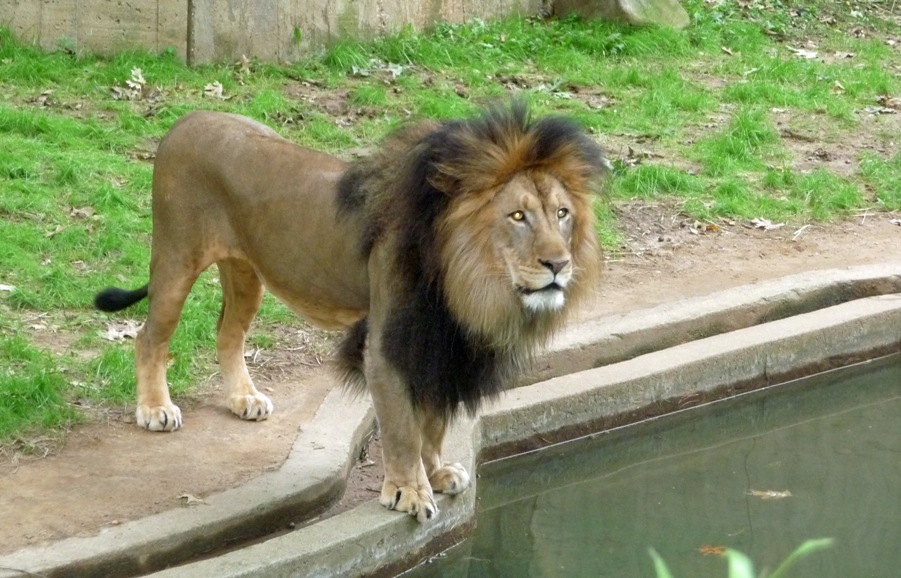
We did spend a good amount of time watching a lion watch us. You could almost see the little wheels turning in his lion head trying to figure out how to get past the moat and over the wall to all of those tasty humans. Just to be safe, I made a point of standing near a bunch of slow looking women and children, because you can never be too careful in situations like that.

We took up residence near this little guy in Freehold, NJ. Having never seen a black squirrel before, and being naturally inquisitive, I Googled “black squirrel” to see if they are the same creature as the grey ones we’re more used to seeing (they are). But as luck would have it, the second link on the Google page was to the Black Squirrel Bar in Washington, DC, our very next stop. Even more fortunate, the Black Squirrel is just a couple blocks away from our favorite Korean restaurant, Mandu, where we had already planned to meet a friend for dinner. Another sign? Without question.
The Black Squirrel calls itself a “gastro pub,” which I guess is supposed to mean they have good food. We didn’t go there to eat, but we did sample a calamari and vegetable appetizer dipped in tempura batter and served with chipotle tartar sauce. It was a little salty, but certainly better than the standard pub grub. They also claim to serve Belgium’s best wheat beer, (it’s not). Fortunately, they have plenty of other options on the menu, including some fantastic beers made by Great Lakes Brewery in Cleveland, Ohio. We’d never heard of Great Lakes before, but a helpful bartender introduced us to them, and now we’ve added another place to stop on our to-do list.

There are few things I care less about than college football (golf, maybe, but that’s beside the point). So while the title of this post has football connotations, my meaning has nothing to do with sports, but rather with college towns. And in this regard, Yale’s New Haven, Connecticut, dominates Harvard’s Cambridge, Massachusetts. Although it is true that we didn’t really spend enough time in either destination to fairly compare, what else are covers for if not to judge books? So we judged, and declared New Haven the winner.
New Haven just felt more to us like what a college town is supposed to be, with its open greens and Gothic Revival architecture. It is a stark contrast to New York City, where Shannon and I both went to school. We decided it would be nice to enroll here and study something pointless, like Romance Languages or Art History. But that is too much of a commitment. Instead, we availed ourselves of their free museums and Frank Pepe’s pizza, reportedly the originator of New England style thin crust. So in the end, we spent the day learning some irrelevant facts and downing a large amount of pizza, just like a regular student.











 Everywhere Once