Ever since our first experiment with AirBnB (where we snagged a New York City...



Ever since our first experiment with AirBnB (where we snagged a New York City...

Just imagine, you’re in the Rome airport staring down the barrel of a...

It doesn’t seem possible, but it is completely true. Traveling 365 days every...
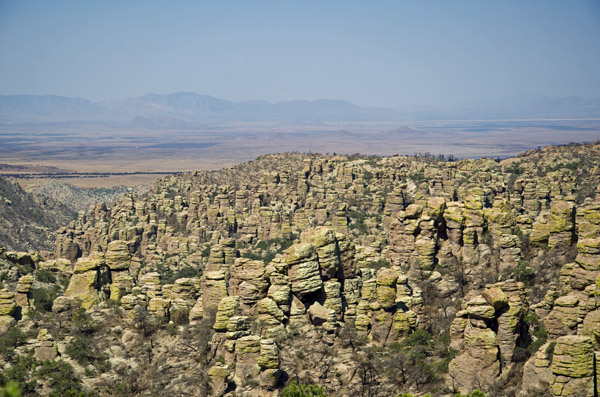
Apache Indians called the area that is now Chiricahua National Monument “the land of standing up rocks.” Much later, European settlers called it “a wonderland of rocks.” We simply called it awesome.
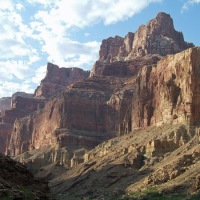
In this remote area of Southeastern Arizona, columns of volcanic rock seemingly grow hundreds of feet in height, in fields that stretch as far as the eye can see. Upon seeing it for the first time, Shannon and I both thought of Colorado’s Garden of the Gods, only dressed in green. But the comparison is somewhat tenuous. Where Garden of the Gods is finely manicured, petite and photogenic, Chiricahua is rough, ruggedly handsome and massive.
After a spectacular sunset, we awoke to our favorite Warner Brothers cartoon. The Road Runner stayed for some breakfast seed.

But Bugs Bunny, seeming distraught at having made a wrong turn in Albuquerque, didn’t linger.


Images sourced from freedigitalphotos.net
“Check-in isn’t until noon.”
“It’s noon where I came from,” I replied, to no avail.
Unbeknownst to us, our short drive had taken us into “Arizona time,” which just happened to be an hour earlier than we planned and apparently an hour earlier than our campsite was ready to accommodate us.
One might forgive our confusion. You see, Arizona follows Mountain Standard Time, except for when and where it doesn’t. We unfortunately arrived at one of those places and at one of those times.
From mid-March to early November Arizona is really on Pacific Time, except for the Navajo Nation, whose clocks read an hour earlier. For the rest of the year, all of Arizona, including the Navajo Nation, follows Mountain Time. Got it? Neither do I, really.
All of this leaves us wondering, what is the point? Not specifically about the peculiarities of Arizona time but the point of time zones in general.










 Everywhere Once