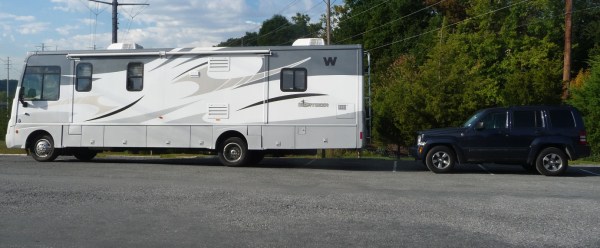
 The convoy has rolled to its final stop. We traded in our Audi for a Jeep in New Jersey, and got our tow assembly installed in Washington, D.C. For those who’ve asked us, incredulously, over the past several months why it’s taken us so long to set up, it’s because the whole thing is a bit of an ass ache. You can’t just throw a couple of bungee cords on the bumpers of any two vehicles and head off. The list of stuff needed to make this work reminds me of an earlier “Reality Bites” post. Things are never as easy as they should be, or as they seem.
To get ready to tow we needed to trade in our car. Call this “Ass Ache Number 1.” We liked our car and didn’t plan on parting with it for a long time. So running off to get a new one wasn’t something either of us was excited about. And our choices of new vehicle were severely limited. Most cars can’t be towed with all four wheels on the ground; even fewer with automatic transmissions can be. So we had to give up a car we liked for one that we were lukewarm on, at best. Yay! Our choices were further constrained by weight issues. The trailer hitch and the motor home itself are only rated to tow so much weight.

Height also ended up being a limiting factor, and one that we almost overlooked. Tow bar manufacturers recommend a vertical difference of no greater than four inches between the motor home trailer hitch and the tow vehicle base plate connection. After some research, we discovered that the base plate pegs for the Honda Fit, our original tow vehicle of choice, were 13.5 inches off the ground whereas the tow receiver on our motor home is 22 inches. Math is hard, but even I can figure out that 22 minus 13.5 is quite a bit more than 4. It is more than 4, right?

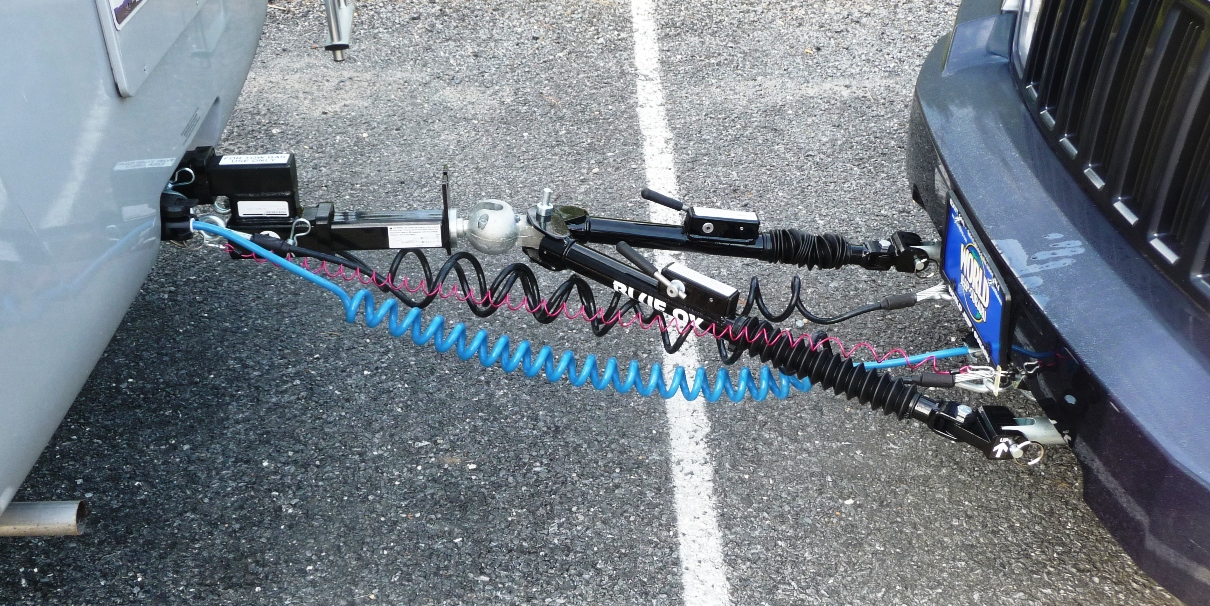
A robotic breaking system for our Jeep
Keep in mind that there isn’t anyone who will tell you this. You have to figure nearly everything out on your own, and hope you don’t mess it up too badly. Had we bought the Fit as originally planned, we probably wouldn’t have been able to tow it without a dolly. That would have qualified as a bad hair day.
After we side stepped that landmine, all we needed was a tow bar, base plates, safety cables, wiring to connect the tail lights of the motor home to the tow vehicle, a supplemental breaking system, and a mechanic to install it all. Piece of cake.
Setting this all up adds about thirty minutes to the front end and probably fifteen minutes to the backend of our travel time. It adds 20 feet of driving length to our 35 foot motor home and raises a whole host of potential problems, limitations, and hazards while in transit. But somehow this still seems more sensible than driving across country in tandem. Not by much, though.
























 Everywhere Once